

7th January 2022 7 MIN READ •Talos ATS •Hiring Tips

Remote working has created an all-new workplace challenge for HR professionals as they look to adapt their current, well-established employee onboarding process to deliver the same results when onboarding remote employees.
Here, we discuss some easy and effective ways you can tweak your onboarding process and improve your remote onboarding strategy.
Table of Contents
What is remote onboarding?
Remote onboarding is the process of inducting and integrating remote employees into your business. For most businesses, onboarding takes place right after a contract offer is accepted. Onboarding remote employees can involve training, HR introductions, essential background screening, onboarding microsites, and the more informal steps of getting to meet their colleagues.
As is to be expected, completing these steps when employees are working remotely is often difficult. But, by following the best practices for remote onboarding, it’s more straightforward than you might think.
Onboarding remote employees with ease
When a new remote employee is joining your business, it’s even more crucial to provide a strong remote onboarding process. Here’s how to ensure you onboard remote employees correctly, so your new hires get off to the best start with your business:

1. Provide personalised welcome packs
When onboarding remote employees, ensure they’re provided with welcome packs and employer brand material well in advance of their start date. This will help them become more familiar with their new employer and the wider business surrounding their role.
It’s always important to ensure remote onboarding welcome materials are personalised for each new remote employee. Stick to remote onboarding best practices and include details relating specifically to their department, colleagues, role, and specialist area.
2. Introduce remote employees to their colleagues
It’s vital to instill a sense of team spirit within your new remote employees. Next in your remote onboarding process, introduce new starters to their colleagues throughout the wider business by using video calls and meetings.
Video meetings will ensure a comfortable and supportive start with your business, encouraging collaboration despite working remotely.
3. Set up equipment and software ahead of their first day
Remote employees will likely rely on multiple software tools in their day-to-day roles. So, when onboarding remote employees, it’s imperative to ensure all equipment and software are set up and ready to go for their first day – including login details and work laptops.
If you’re posting equipment out when remote onboarding, make sure you allow plenty of time for this to arrive before their first day.
4. Use remote onboarding microsites
Using an onboarding microsite makes it easier for your HR team to manage your remote employees. Remote onboarding microsites enable you to track each new starter through every stage of their onboarding and ensure they have all the info and resources they need.
Best practices for remote onboarding all mention the use of advanced hiring software to ensure a well-structured process. Our intuitive applicant tracking system, Talos ATS, comes with built-in remote onboarding tools, allowing you to easily track and manage your new remote employees as they get closer to their first day.

5. Utilise video communication
While emails and instant messaging services are certainly quick and the go-to for remote onboarding – they lack the connective and often emotional nature of a face-to-face chat.
By using video communication tools when onboarding remote employees, you can provide managers and their new remote hires with a close alternative, helping remote employees feel like a part of the team from day one.
6. Produce remote onboarding guides and documents
Onboarding remote employees with guides to any software/processes involved in their work is key to ensuring a positive start.
Best practices for remote onboarding focus on the importance of collating documents specific to the company into a ‘welcome pack’ for new remote team members that can contribute to a faster turnaround from ‘trainee’ to established employee.
7. Use applicant tracking software to familiarise new recruits
By using an applicant tracking system, such as Talos ATS, throughout the recruitment process and your remote onboarding, new employees can familiarise themselves with company culture before they begin working.
This not only helps to get remote employees off to a great start but also increases employee retention.
8. Host a ‘stand up’ and ‘stand down’ each working day
Many companies have formulated a day-to-day structure to help employees cope with remote onboarding.
By hosting ‘stand-up’ meetings at the beginning of each day, new remote employees are able to familiarise themselves with the daily goals associated with their role. Similarly, the end of the day ‘stand-down’ meeting is a nice way to wrap up the day, and can help employees new and old to evaluate their achievements.
For more tips on onboarding remote employees, download our free onboarding checklist.
Best practices for remote onboarding
It’s crucial to get your remote onboarding strategy right, especially when new staff are starting their first day virtually.

Here are a few ways that companies can tweak their onboarding strategy to align with best practices for remote onboarding and get new remote employees off to the best start:
1. Avoid unnecessary pressure
When new recruits are starting their jobs remotely, pressure can often mount quickly in unnecessary places.
By approaching new remote onboarding processes slowly, and in a manner that is friendly and understanding, new recruits are made to feel ‘at home’ within the company, no matter how distant they may be physically.
2. Set up a ‘meet the team’ session
In a physical office environment, departments can mix and merge in break rooms, communal areas, and staff socials.
With remote working, this is not the case – leaving new staff feeling as though they are not properly connected with colleagues.
As part of your remote onboarding process, set up ‘meet the team’ sessions with different departments. New remote employees are able to recognise the wider culture and community of the business and their part within this.
3. Schedule regular virtual meetings
Showing our faces on a webcam can be scary at first! Making sure that we look presentable, and that any ‘out of place’ possessions or pets are well hidden, for example. However, it has become a crucial way of connecting with our colleagues during the remote onboarding process.
Email, text, and instant messaging can be life-saving tools, but they do not replace the comfort of a face-to-face conversation! Engage with remote employees through video calls to make them feel more settled within the business.
How to train remote employees
After a strong remote onboarding strategy, an equally as strong training strategy is crucial for bringing new remote employees up to speed. When new recruits are working from home, it’s even more important to build an effective training plan…
1. Maintain regular high-quality contact
When onboarding remote employees, keep in touch with your new starters to ensure they’re consistently supported throughout the training process. Talk them through each step of their learning journey and offer advice when required.
2. Lead virtual inductions and training sessions
If you’re onboarding multiple remote employees at once, you might want to lead group sessions to make the process easier. This not only allows you to engage with more new recruits over a shorter period of time, but also encourages peer-to-peer support if needed.
Training on a one-to-one basis during your remote onboarding process can be intense for any new recruit; this experience can become even more taxing. Leading group sessions with new remote employees promotes collaboration between your new starters while instilling a sense of familiarity in your team.

3. Prepare digestible guides to core processes
Instead of leading one-to-one training sessions during your remote onboarding process to cover every last detail of core processes, try making digestible guides for new employees to read through themselves.
This saves time for you and your HR team, increases the speed of your remote onboarding journey and promotes employee autonomy from the very beginning.
4. Hold weekly reviews to assess their progress
Reviewing your new employee’s progress is crucial when following best practices for remote onboarding. Review your new starter’s progress by holding weekly one-to-one reviews. Use video calls to stay in touch and provide support through a more face-to-face medium.
This gives new employees the opportunity to seek advice and address any issues they may be having during their remote onboarding process. Regular catch-ups ensure you remain up-to-date with their progression while getting them off to a strong start with your business.
How has remote working changed onboarding?
While remote working is nothing new, many businesses have had to adapt their processes, and remote onboarding is just one of them.
While every aspect of business has been affected by the rise of remote working, recruitment has been one of the hardest hit. The challenge of attracting & onboarding new employees remotely is not one to be underestimated.
Thankfully, there are many solutions for businesses seeking to hire staff remotely. Talos has all the tools you need to launch a successful, engaging remote hiring strategy.
Can new employees start their new roles from home?
While starting a new job from home may seem daunting, with the right remote onboarding support, it can be as successful as traditional face-to-face onboarding.
It’s entirely possible for new remote workers to begin their roles from home, as long as employers follow the best practices for remote onboarding and the right employee onboarding software available to induct them correctly.
Remote working has been a popular choice for a large number of businesses, with almost 30% of UK workers currently in hybrid or remote positions. Working from home can present workplace challenges for even the most seasoned employees, meaning that those new to their jobs face a whole new challenge in learning the ropes.
Best tools for onboarding remote employees
Talos360’s next-generation software, Talos ATS, provides you with all the tools necessary to turn new remote employees into successful members of your team quickly and effectively.
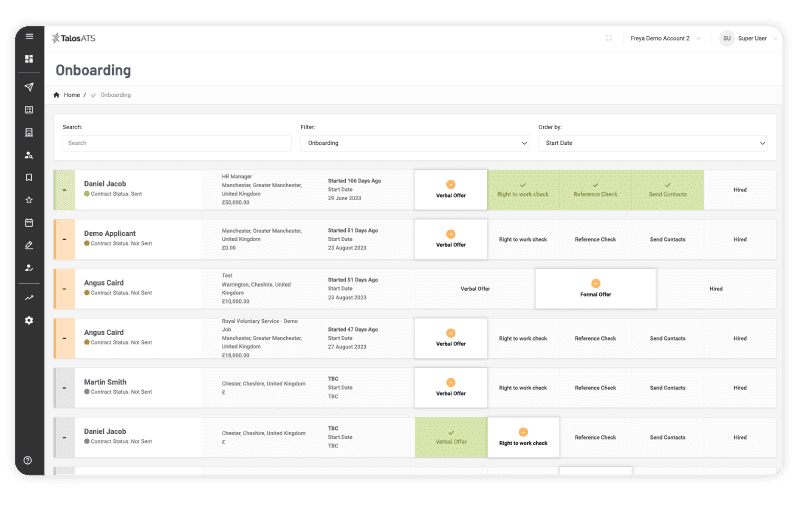
The intuitive hiring platform uses the latest remote onboarding tools to provide a fast, efficient, and user-friendly hiring and onboarding experience – for both your colleagues and candidates!
From advanced talent pooling and remote video interviewing to integrated onboarding microsites to in-system right-to-work checks, background checks and e-contracts, Talos ATS is the ultimate, all-in-one hiring and onboarding solution.
Remote onboarding tools from Talos ATS:
- Intuitive Applicant Tracking System
- AI-powered video interviewing platform
- Automated SMS/email communication
- Recruitment advertising across multiple platforms
- Automated candidate screening & compatibility analysis
- Remote onboarding microsites
- Essential background checks and right-to-work checks
- Integrated with leading HRIS for seamless onboarding
- Reference checking portal
- Advanced onboarding dashboard
Make sense of remote onboarding with Talos ATS