
12th May 2023 11 MIN READ •Talos ATS •Hiring Tips
Key takeaways
- The 7 steps of the recruitment process are planning, analysis, attraction, screening, engagement, selection, and onboarding
- The hiring process needs to start with a planning stage, where the vacancy and its requirements are defined
- Next, analysis is required to determine who exactly you’re looking for
- Applicants then need to be attracted via optimised, widely shared job adverts and an accessible platform, such as an applicant tracking system (ATS)
- Candidate screening must follow, and this can be automated via Talos ATS to speed up the process and reduce admin
- There then needs to be a process of candidate engagement, involving initial communication, an interview, and candidate assessment
Finally, the last stage of the recruitment process is to select a candidate, supported by data insights provided by your ATS.
What is the recruitment process?
The recruitment process is your organisation’s process of searching for, attracting and hiring candidates for a vacant position or role.
“The end-to-end recruitment process covers everything from the moment a job advert is posted to the point when a successful candidate has been fully onboarded.”
While some hiring processes vary, the majority of organisations use advanced hiring software like an applicant tracking system and follow a strategic series of steps that include:
- Planning
- Analysis
- Searching
- Screening
- Engagement
- Selecting
- Onboarding
What are the 7 steps of the recruitment process?
By following the 7 steps of the recruitment process below, you can help to ensure a seamless, hassle-free hiring journey for both candidates and your colleagues.
| Recruitment Stage | Purpose |
|---|---|
| Planning | Identify the vacancy and its requirements |
| Analysis | Determine who you’re looking for |
| Searching | Attract the right candidates |
| Screening | Select which candidates to engage |
| Engagement | Interviewing, connecting, and assessing candidates |
| Selection | Make a data-backed hiring decision |
| Onboarding | Welcome new talent to the team |
With the right tools and a well-planned hiring process, you can attract and retain the best talent in your sector in an efficient, cost-effective manner.
1. Planning
Behind every success is an effective plan, and recruiting is no different. With the right planning in place, you can find, attract and hire the best candidates. During this stage of the recruitment process, you will identify the role you’re hiring for and determine how it will help your organisation.
- Agency vs in house?: think about how you’ll conduct your recruitment campaign. Will you go down the recruitment agency route, or will you use recruitment software like an applicant tracking system to hire in-house? In-house recruitment can be a lower-cost option with more flexibility, visibility, and control over the hiring process
- Identify your current challenges: consider your current pain points and why you might need to open up a new position, so you know what kind of hire you’re looking for. Do you need to make workloads more balanced? Are you focused on business growth? List your challenges as an organisation and think about what type of hire will help
- Specify the vacancy: identify the role you’re looking to fill, its requirements, and your expectations for your new recruit
- Use hiring technology: an applicant tracking system is the perfect hiring software for in-house recruitment teams to attract, manage, engage, hire, and onboard candidates. It gives you complete visibility of the entire recruiting process
- Define your recruitment metrics: tracking the right recruitment metrics will help you identify how effective your hiring campaign was and how you can improve next time. The most common metrics tracked in Talos ATS are time to hire, cost per hire, application completion rate, time to fill, sourcing channel and attrition rate.
Download: A Complete ATS Buyer’s Guide
2. Analysis
Before heading to the job boards, you must first step back and identify what your ideal candidate actually looks like. Thinking about the person you want to hire will put you in good stead later on in the recruitment process when it comes to selection.
During the analysis stage of the hiring process, you also need to think about how you are going to convince top talent to join your organisation. For this, you’ll need a serious employer brand strategy with dedicated career pages and social media campaigns to really promote your employer brand.
- Identify your ideal candidate: take the time to consider what your ideal candidate looks like. Create a checklist that covers qualifications, knowledge of the role and responsibilities, relevant experience, skills, attitude to work, and values
- Promote your employer brand: showcase your employer brand via optimised job adverts, engaging career posts, and social media posts
- Build a careers site: a dedicated careers site is the perfect solution to show off your employer brand. Show everything from what it’s like to work for your company to insight into your workplace culture and employee benefits
3. Attract
It’s then time to hit the job boards and start your search. At this stage of the hiring process, you should start to write your job adverts, choose your preferred job boards, and tap into existing talent pools to find and attract the right talent for your roles.
Keep your ideal candidate in mind and ensure your recruitment advertising is targeting the right people. You don’t want to spend all your advertising budget on unsuitable applicants.
- Perfect your job description: make sure it’s concise and to-the-point. Include essential information only, and avoid corporate buzzwords that might turn candidates off. The Talos ATS AI writing assistant will help you write comprehensive job descriptions tailored to each vacancy
- Make application forms accessible: make sure you choose an ATS with an ‘easy apply’ feature. Talos ATS allows users to generate fully branded one-click application forms, removing any potential barriers and improving the candidate journey
- Use ‘killer questions’: implement ‘killer questions’ on your application forms to automatically filter out unsuitable applicants. These may include years of experience, education level, or availability, for example
- Test your candidate journey: the best way to ensure a great candidate journey is to go through it yourself. Start by checking your job adverts read well and consider whether it’s easy to apply. Then, go through the rest of the recruitment process to identify any hiccups or opportunities to improve
- Craft your job adverts: be personable, always specify the salary, keep the information concise, and choose the right job boards to find the right talent. For certain roles, sector-specific job boards may be the best option
- Use talent pools: good candidate experience is essential for building talent pools. Provide unsuccessful candidates with questionnaires and continue to communicate with them to nurture a pool of talent willing to re-apply for future roles with your business. Using an ATS can help you to track this
4. Screening
Screening is an important step of any hiring process. It helps to identify which applicants have the right experience, qualifications and skills to progress to the next stage. This process will involve reviewing CVs, using video screening software, and conducting candidate assessments.
When done correctly, the screening process will help to identify which candidates are eligible to progress and which ones you can reject and add to your talent pool. It is also important to recognise any potential bias that may be clouding your judgement.
- Set your screening criteria: this will be your guide to refer to when choosing which applicant to progress to the next step. Your criteria should cover desired skills, experience, education, qualifications, and nice-to-haves
- Be aware of hiring bias: candidate assessments provide a data-driven technique to remove unconscious bias from the recruitment process. With the right hiring software, you can use skill-based, personality or psychometric assessments to filter the candidates that best match your role’s requirements. Unbiased recruitment promotes a diverse workforce, bringing different skills, new viewpoints, and creative solutions that can propel your team’s success
- Screen candidate CVs: when screening CVs, be vigilant and keep an eye out for the tell-tale signs of AI generated content. A good candidate CV will be tailored to the role, to-the-point, and will feel like a personal sales pitch for the candidate
- Video screening: using video screening software, you can invite candidates for a short, often casual interview to gain further insight into them and to ask further questions about their CV. Asking the right video screening questions is the key to a successful screening procedure – ask yourself what additional information you’d like to find out before inviting candidates
5. Engagement
The interviewing stage can be one of the longest parts of the hiring process for both candidates and employers. It’s therefore essential at this stage to keep candidates engaged. You should by now have an idea of who you want to progress to the next stage of the recruiting process. Here, you’ll interview candidates who will help you to determine who’ll receive that all-important job offer.
Maintaining contact with candidates during the interview process is key to avoiding dropouts, and keeping your chosen applicants interested. Like with every step, implementing the right hiring software can help speed up the interviewing process and improve candidate experience.
- Determine interview rounds: most interview stages will consist of two interviews. However, depending on the role, you might choose to conduct three or more rounds of interviews to find the right candidate. In some industries, such as retail and hospitality, trial shifts may be a better way to evaluate candidates. This method is also often preferred for neurodivergent candidates, and can help to create a more inclusive recruitment process
- Carefully consider interview questions: the questions you ask will help you evaluate if candidates will be a good cultural fit for your organisation. Plan your interview questions in advance, so you can check candidates share similar values to your company, will align with your organisational goals, and will be a good fit within your team
- Keep candidates informed: respond to interviewees in a timely manner to create a positive candidate experience, as this influences your overall employer brand. Streamline communication with candidates by automating comms via Talos ATS. This is beneficial when you have to reach out to multiple candidates, and reduces the chance of anyone feeling ghosted
- Consider the interview location: are you going to invite candidates to your office, or are you going to interview remotely? If you’re hiring remotely, use video interviewing technology to interact and engage with your candidates. Video interviewing removes the barrier of location, so is a good way to widen your search for the best talent
6. Selection
Candidate selection is the penultimate step of the hiring process. This is where all of the notes you made during the interviewing stage will come in handy. While it’s important to choose a candidate that best suits your criteria, don’t be afraid to trust your gut.
It’s important to take the time to make the right decision, but don’t over do it. The longer you take, the more likely candidates are going to seek other opportunities and accept other job offers.
- Make data-driven decisions: use the score cards within your applicant tracking system to determine which candidates best match your desired skills, experience, attributes and values, eliminating bias
- Consider cultural fit: it’s important to hire a candidate that aligns with the culture, vision and values of your organisation
- Think about the future: are you choosing a candidate because they are right for the role now? What about in a year’s time; will they have made the progression you would have liked to see? Hire the candidate that is not only right for you now, but has the desire to grow and develop with your company
- Stay compliant: ensuring recruitment compliance is essential, so take the time to understand the required checks for your roles. This will include Right to Work checks, as well as role-specific background checks, such as enhanced DBS checks, directorship checks, or FCA checks
- Automate reference and background checks: automated reference checking and background checks, such as DBS checks, allows you to streamline the process and reduce the time spent on administrative work
- Awarding a job offer: when you’re ready to offer the job, it’s important not to put all of your eggs into one basket in the event a candidate doesn’t accept the offer. Have a backup candidate in mind just in case. If you’re delivering a dreaded rejection email to a candidate, be personable and compassionate and thank them for being part of your recruitment process – you may want them to stay in your talent pool for future hires
7. Onboarding
The next step is to ensure your new starter is ready for their first day. This final stage of the recruitment process includes preboarding and utilising onboarding microsites. Make sure to keep your new employees engaged during this stage with regular catch-ups, frequent communication, and a comprehensive onboarding checklist.
- Don’t neglect preboarding: preboarding is the time between a candidate accepting their job offer, up until their first day. Consider what information you can provide prior to their start date to make them feel like part of the business
- Use onboarding microsites: an onboarding microsite can be incredibly useful for communicating key information. Microsites provide essential new starter information from a first-day schedule to new starter FAQs and are accessible via most applicant tracking systems
- Keep new hires engaged: employee retention starts with recruitment. To ensure new starters don’t leave prematurely, your onboarding process needs to be engaging. Take the time to answer any questions they have, order all equipment before they arrive, schedule regular check-ups, and consider assigning a mentor or buddy to new starters
Tim Clifford, Talent Insights Specialist at Talos360, said: “Embrace applicant tracking systems, onboarding software, and employee engagement software to support this part of the recruitment process. Use performance management software to continue to track performance following onboarding too.”
Download: The power of onboarding
Types of recruitment
Each company has its own approach to recruitment, and what works for one may not be the most effective method for another. The different types of recruitment include:
- Retainer recruitment: retainer recruiting involves hiring an external recruitment agency. The external agency is typically paid a fee upfront and will work exclusively for your business until they find a suitable candidate to fill the role
- Contingency recruitment: this type of recruitment also involves hiring an external recruitment agency; however, the external recruiter will only receive payment once they have successfully positioned a candidate in the role
- Reversed recruitment: reversed recruiting involves a candidate reaching out to your company or hiring manager to initiate discussions around recruitment. Reversed recruitment is most likely to occur when a candidate has a specific company that they’d like to work for, and an opening that matches their skillset becomes available
- Direct advertisement: this is when a company uses internal resources to advertise their vacancies. For example, talent acquisition may be initiated on job boards, social media platforms, or career websites. While this method can be effective for employer brand awareness, it can also bring in unqualified candidates
- Employee referral programmes: an employee referral programme is an initiative that encourages employees to recommend their own personal network for open roles. Employee referral schemes are often cost-effective, as in most cases, the referee will only receive some form of compensation should their referral be employed and successfully onboarded. As your employees understand the company culture and operations, they are likely to refer candidates who share similar values and would be a good fit for the organisation
- Outplacement recruitment: outplacement recruiting is when an employer helps a former employee secure a new job by recommending them for an external role. This type of recruitment is often offered as a benefit to support employees in finding new employment after their time with the company has ended
Benefits of an effective recruitment process
Having a reliable recruitment process in place greatly increases your chances of quickly finding the right person to support your organisation’s growth and development. The benefits of an effective hiring include:
1. Save time
Rather than subjecting candidates to a long, complex recruitment process, applicant tracking systems create a more personalised and positive experience for the employer and candidates. An ATS streamlines daily recruitment tasks, allowing recruiters to focus on higher priorities. Applicant tracking software also helps identify bottlenecks that lead to bad hires, enabling quick fixes and saving significant time.
2. Increase employee engagement
Engaged employees are typically more motivated, dedicated, and enthusiastic about their work. A hiring process that aligns with your personal specification can help to predict a candidate’s potential commitment to your company. Interviews are especially effective for assessing a candidate’s enthusiasm and fit for the role, as you can ask targeted questions that reveal:
- The candidate’s motivation for joining your company
- Their understanding of the role
- How their values align with your organisational culture
3. Proactive recruitment
A well-structured recruitment and selection process enhances both recruitment strategies and team performance by identifying gaps early and keeping the team aligned. A proactive approach allows recruiters to refine strategies in real time, leading to higher-quality hires.
With a solid recruitment process in place, hiring becomes more manageable, enabling your team to focus on finding candidates that fit your business, budget, and role requirements. By regularly evaluating the factors that attract and influence new hires, you can address any issues in the recruiting process, and highlight the benefits that make you a more attractive employer.
4. Improve performance
A well-designed recruitment and selection process not only sheds light on a candidate’s competence and skills – key indicators of future job performance – but also improves the efficiency of your recruitment strategy. Skilled recruiters use the interview process to reveal the candidate’s strengths, limitations, and areas for improvement, which are crucial in predicting their future productivity.
With a solid recruiting process in place, your hiring team can more effectively identify and evaluate suitable candidates, giving you more time to focus on finding the right fit for your business, budget, and vacancy.
8 tools to enhance the recruitment process
There are many tools and technologies that can enhance the recruitment process further, streamlining the different stages, saving time and money, and reducing admin. These tools include:
- Job portals: list your vacancies to connect with potential candidates
- Social media: advertise roles across LinkedIn and other professional networking platforms to attract a wider talent pool
- Jobs boards: post vacancies to national and industry-specific job boards via the Talos ATS multi-jobs board poster
- AI: use automation to streamline the recruiting process, and take advantage of AI writing tools to support your job ad and job description creation
- Careers websites: build a careers site to host job descriptions, and showcase your employer brand and workplace culture
- Applicant tracking systems: manage the hiring process end-to-end with an ATS
- Video interviewing software: host interviews remotely using video interviewing technology to remove location as a barrier to hiring
- CRM: use candidate relationship management software enables hirers to engage with candidates and build talent pool databases
Read more: ATS vs CRM: everything you need to know
Introducing…
Talos ATS: Hire faster, smarter, with less manual effort
Finding hiring difficult? It’s time to discover Talos ATS…
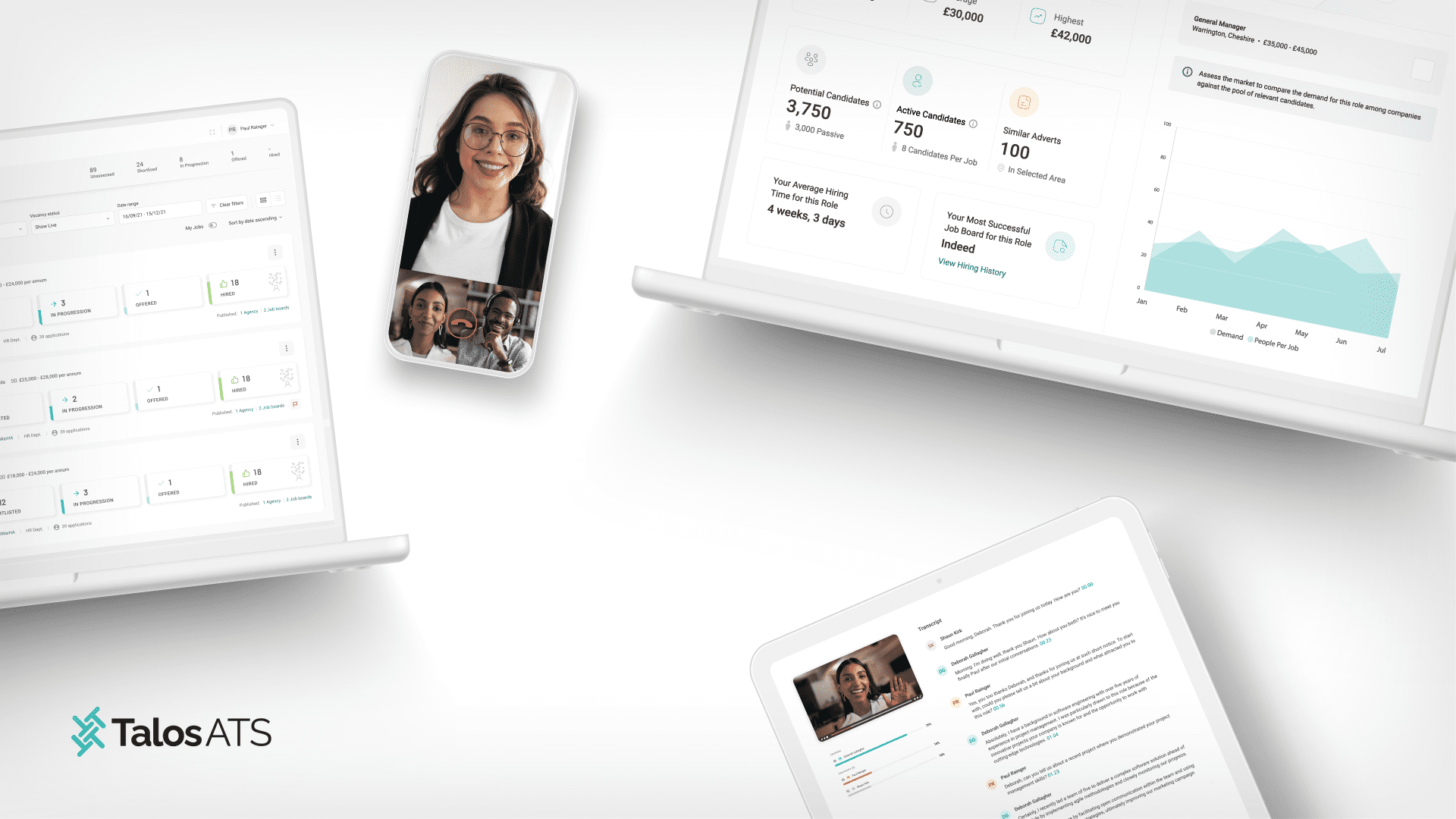
Talos360’s applicant tracking system is an AI-powered hiring software solution providing employers with a faster, data-driven solution across each of the 7 steps of the recruitment process. Providing businesses with an easier way to attract, manage, hire, and onboard strong candidates, it’s recruitment technology you can’t afford to miss.
Automate your recruitment process
Using our intelligent candidate screening automations, you’ll be able to identify and prioritise your most compatible candidates from the moment they apply at the very start of the hiring process.
This saves a huge amount of time for your HR team, while promoting positive, data-backed hiring decisions.
With Talos ATS, you gain access to an intuitive applicant tracking system, recruitment advertising suite, and virtual interview room – all compiled into one user-friendly dashboard.
Talos ATS includes:
- Easy to use applicant tracking system
- Multi-platform job-poster
- Automated progression of your strongest applicants
- Recruitment advertising suite
- Video screening and interview platform
- SMS/email update automation for candidates
- Remote onboarding tech tools
Discover an easier way to manage the end-to-end recruitment process – cut costs and save time with Talos ATS: