
6th July 2023 8 MIN READ •Talos ATS
Whether you’re hiring for a junior position or searching for a new CEO, background screening is a crucial component of any recruitment process and onboarding checklist.
Selecting a suitable background screening process and conducting employment background checks ensure candidates are eligible for their role, preventing employers and in-house recruiters from hiring talent who aren’t qualified or pose a risk to an organisation.

In Talos360’s guide to background screening we discuss which UK background checks are required and why, how long background checks take to complete and explore the UK’s most used employment background checks, including:
- DBS checks
- Enhanced DBS checks
- NHS DBS checks
- FCA checks
- Social media checks
- Employment verification checks
- Right to work checks
Table of Contents
What is background screening?
Background screening, also known as background checks, are pre-employment checks carried out by third-party screening providers to allow employers to identify risks associated with an individual when hiring.
Typically, employers utilise background screening to verify a candidate’s identity or information, such as previous employment and education.
When hiring, organisations implement employment background screening to identify potential risks a candidate may bring to the business, such as an unknown criminal record or failing to have the required qualifications for the applied role.
Why are background checks important?
For employers, it’s a challenge to acquire all the information they need to hire talent from their CV alone, especially when the information available is false or misleading.
This is where employment background checks come into a league of their own. Background screening is the first line of defence for hiring managers and other HR professionals. Here are just some reasons why we think background checks are so important.
1. Protection for businesses
If a candidate has withheld or provided false information on their CV, background screening ensures employers can access the information they need to make a hiring decision. Background checks prevent the chances of businesses recruiting potentially dangerous candidates.
2. Protection for candidates
By carrying out essential background screening, candidates can be certain that they are joining a legitimate organisation that abide by current employment law guidelines and recruitment compliance legislation.
3. Remain compliant
Depending on the roles you are hiring for, there are a number of pre-employment checks you must conduct to remain compliant. For example, when hiring within the education industry, especially roles working with children, candidates will be required to complete Enhanced DBS Checks before they can progress through the recruitment process.
Fail to keep up with these checks and you could face some hefty fines or even a court date.
4. Protection for current employees
Employment background checks are also crucial for ensuring the safety of current employees and preserving an organisation’s reputation. Employers can request candidates to take criminal record checks to ensure they pose no threat to a business, helping them avoid any potential workplace harassment or workplace safety problems.
What background checks do UK employers use?
There are over 20 different types of UK background checks employers can utilise when hiring. Each background check will look significantly different for each organisation and vary from role to role, with some higher-risk roles requiring longer and more thorough checks.
With so many different checks available to employers, it’s often difficult to decipher which checks are necessary and how to conduct background screening in the most effective way possible.
One solution to this challenge is working with an organisation to identify who needs background checks and to assist you in conducting employment background checks. At Talos360, we not only assist you in choosing the correct checks but also support you building an effective onboarding process with our fully integrated ATS (applicant tracking system).

What employment background checks should you make?
The type of pre-employment background checks required for a role can depend on several factors, from the individual role to the sector the role operates within.
Every candidate must undergo right-to-work checks to ensure their eligibility to work in the UK. Other roles posing a higher risk will require more extensive checks to stay compliant with the legal requirements of their respective industries.
For example, hiring in the education or care sector will require enhanced DBS checks, including criminal record checks, as their role involves working with vulnerable adults and children.
Besides essential background screening, employers can carry out extra employment background checks to help reduce hiring risk, granted the role meets the requirements. There are many background checks organisations may require when hiring, from social media recruitment screening to financial conduct authority (FCA) checks.
Commonly requested UK background checks
In addition to a role’s legally required background screening, employers can implement other pre-employment checks to reduce risk to and protect an organisation when hiring.
1. DBS Checks
A Disclosure and Barring Service (DBS) check is utilised to identify whether an applicant has a criminal record. These essential background checks are standard within the UK and are required in several industries to verify whether an applicant poses a risk before working for an organisation.
Employers can conduct a basic, standard or enhanced DBS check depending on the position they’re hiring for. DBS checks show any ‘spent’ and ‘unspent’ convictions, whereas enhanced DBS checks will show the same information but share additional information shown on police records. Typically, how long DBS checks last depends on the candidate, as the data is only accurate at the time of completion.
2. Employment Verification Checks
Employment verification checks validate candidates’ information on their CVs, such as previous job titles, dates of employment and previous employers.
Unlike reference checks, employment verification checks offer a deep dive into an applicant’s employment history, uncovering any unexplained gaps and discovering any undesirable conduct in an applicant’s history.
3. Social Media Check
Social media screening is the process of investigating a candidate’s activity across their social media accounts, including LinkedIn, Facebook, and Instagram. These background checks are typically carried out by an employer, recruiter or a third party.
Social media checks highlight any adverse activity that may pose a risk to an organisation. Despite no standardised approach to social media screening, several factors are considered a concern.
- Displays of information which differs from an applicant’s CV
- Derogatory or inappropriate language
- Illegal or inappropriate behaviour
4. Directorship Check
When hiring for any senior-level role, employers must turn to more comprehensive employment background checks to ensure a candidate is eligible to fill a role. A directorship check is required when filling vacant senior-level roles to ensure that candidates are qualified to fill a director role.
Directorship checks involve investigating an applicant’s current and past directorships and highlighting if your candidate is barred from being a director.
A directorship check is an example of a pre-employment background check necessary for any senior-level role. Hiring for senior roles holds more risk, as the wrong hire could prove detrimental to an organisation.
5. FCA Checks
Financial Conduct Authority (FCA) background screening is essential for candidates applying for positions of authority and trust within the financial sector.
FCA checks consist of multiple other checks, including credit checks, criminal records checks, and employment history. Employers hiring for financial positions must ensure they pay due diligence and conduct the necessary FCA checks to confirm people are ‘fit and proper’ for their applied role.
What do background checks cover?
Background checks can cover many different areas depending on the background screening your role or industry requires. Background screening can cover several concerns employers may need to know before hiring a candidate, from their criminal history to employment and educational history.
What do DBS checks cover?
DBS checks are criminal record checks that cover a candidate’s entire criminal history, sharing any spent and unspent convictions with an organisation and if a candidate appears on any barred lists.
What do FCA checks cover?
FCA checks cover several types of background screening, including identity, financial, educational, employment, and criminal record checks.
Social media checks review candidates’ social media channels, identifying any harmful behaviours, privacy breaches, negative afflictions and threatening behaviour online.
What do employment verification checks cover?
Employment verification checks review a candidate’s employment history from the beginning of their career to ensure candidates are truthful about their employment history.
What do directorship checks cover?
Directorship checks review a candidate’s employment history to ensure they are capable of filling a senior position in a business.
What are the benefits of background screening
Employment background checks are essential for every business, regardless of their industry. However, just because background screening is a necessity doesn’t make it any less beneficial for businesses. Here are the benefits of background screening businesses are sure to experience.
1. Remaining compliant
Conducting background checks will keep your business on the right side of the law and ensure you remain compliant with the specific requirements of the industry in which you operate. Remaining compliant not only protects your business from legal action and costly fines but also makes an excellent case for your employer brand and helps protect your people.
2. Avoid hiring risks
Hiring the wrong person for a role can be costly, but hiring someone who isn’t eligible to work is far worse. By conducting the correct background screening, employers can ensure their new hires are fit to work for their organisation and avoid any possible issues with employees and hefty fines.
3. Improved quality of hire
Background screening isn’t just crucial for hiring compliance; it helps to improve the quality of hires coming into your business. Background checks allow organisations to make better-informed hiring decisions, hiring applicants with the right experience while meeting the legal requirements of the role.
4. Reduce turnover
Background checks aren’t just important for businesses; they’re crucial for employees, too. Employees are more inclined to work for an organisation that is compliant with recruitment legislation. Failing to conduct the correct background checks could make businesses vulnerable to high staff turnover as employees feel unsafe in their organisation.
How do UK background checks work?
While there is no standardised way to conduct employment checks, most employers tend to conduct their background screening before a job offer is sent, most commonly shortly after the interview scheduling stage of the recruitment process.
Conducting checks before sending a job offer ensures that the chosen candidate is eligible to work and has the credentials to begin their new role immediately, speeding up the employee onboarding process.
However, there’s usually more than one candidate on a shortlist, which means more employment background checks to conduct. This drives up the cost of recruitment and brings the time to hire right down.
Conducting background screening after a job offer can help reduce costs, as only one candidate can review. However, if said candidate fails one of their tests, you run the risk of starting the process again, meaning a longer time to fill that role and a prolonged time to hire.
Once the pre-employment background checks have been received and processed by a third party, employers will be notified of their request details and results. It is then up to the employer, recruiter or HR professional to make any further decisions on the candidate’s journey.

How long do UK background checks take?
The processing time for background checks can vary – depending on the type of pre-employment background checks employers opt for, but they should take no longer than four weeks.
For some background checks, the processing time is increased due to the high level of investigation that goes into the screening process. For example, right-to-work checks will be considerably faster than enhanced DBS checks.
How far back do background checks go?
Most background checks will last for 7-10 years, but this can vary depending on the type of background screening you undertake.
Employment verification checks can stretch back as far as 10 years to give employers a complete picture of a candidate’s employment history. Other employment background checks have a much shorter shelf life. While DBS checks do not officially have an expiration date, they are only accurate when they are conducted.
Here is a list of how far back background checks go:
| Types of background screening | How long will they last? |
|---|---|
| Employment verification checks | Typically, these background checks will last 7-10 years. |
| DBS checks | DBS checks will go as far back as the police records |
| Credit history checks | A minimum of 7 years |
| Social media checks | Some organisations will look back at the past few months, while others will review the last several years |
Background screening FAQs
Background screening is the process of conducting the necessary pre-employment background checks required for the role you are hiring for. Background screening is a crucial stage in the recruitment process, helping organisations remain compliant. Some common types of background screening are criminal record checks, employment verification checks, social media checks and directorship checks.
Background checks can show an employer a candidate’s criminal history, employment history, education history, credit history, social media history and even any history of bankruptcy. The contents of background checks will depend on the type of background checks a business conducts.
The best background check services integrate with recruitment technology, such as an applicant tracking system. With an ATS in place, recruitment teams can conduct background checks directly from their system, negating the need to go to external background check providers.
Background checks help businesses remain compliant when hiring while ensuring they select a candidate eligible to work for their business. Background checks help employers make better data-driven decisions, ensuring they hire the right person the first time.
Introducing...
Employment background checks from Talos ATS
One of the biggest challenges with background checks is the cost and time it takes to conduct essential background screening. Not only do pre-employment checks eat at admin time, but they can bring an organisation's time to hire right down.
So, to help HR professionals preserve their time and help candidates get into their roles quicker, Talos ATS has introduced background checks to their advanced ATS.
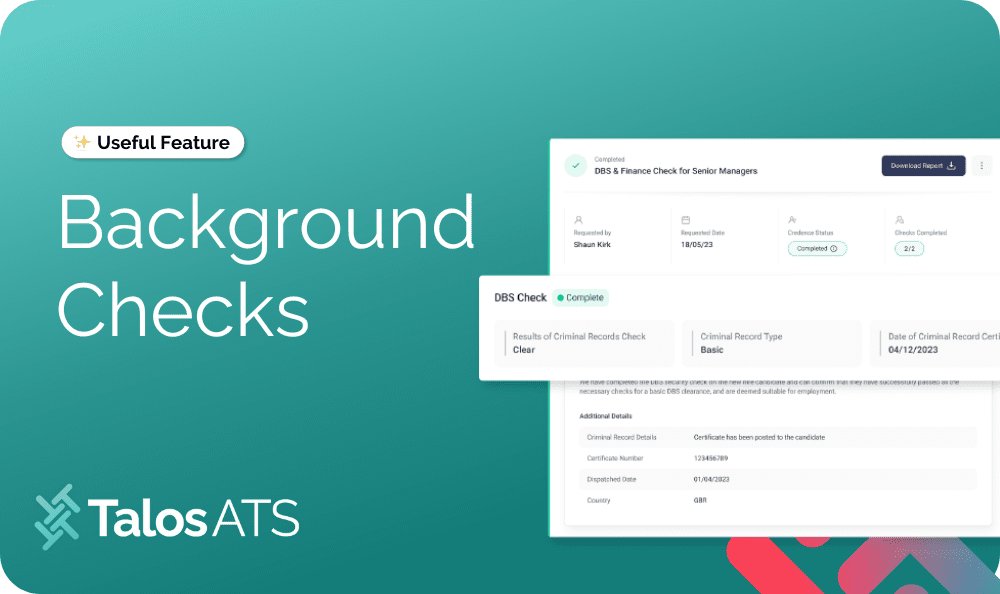
Talos360's latest feature enables users to request, view and track background checks directly from their recruitment software, streamlining the recruitment process.
Streamline your background screening process
With Talos360's integration with Certn background screening, you can say goodbye to multiple log-ins and access over 20 pre-employment background checks directly from Talos ATS.
Our background checks allow you to save time on unwarranted admin with customisable, real-time notifications, updating you on the progress of your employment background check requests.
Ensure you remain compliant throughout your recruitment process
Provide the right background checks for your organisation today with background screening from Talos ATS.
Discover Talos ATS Background Checks