
14th January 2025 10 MIN READ •Resources •Talos ATS
Interviews are among the most important parts of any recruitment process for both candidates and employers. So, it’s well within your interest to get this right first time!
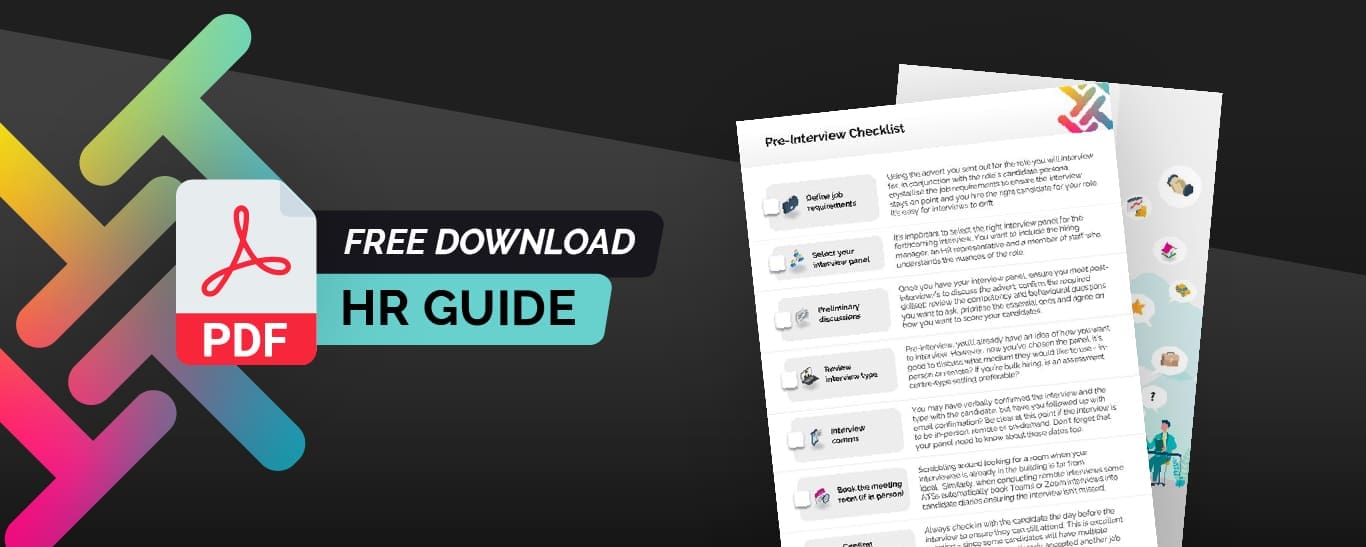
To help you do just that, Talos360 has put together a downloadable interview checklist for interviewers, designed to take employers and hiring managers through each step of the interview process, so they have the structure required to make the best possible hiring decisions.
Key takeaways
- An interview checklist helps employers to manage the job interview process efficiently. It provides a framework for interview prep, and keeps the interviewer focused during the interview itself to ensure the most suitable candidate is hired
- Using an interview checklist offers multiple benefits, including providing an opportunity to gather better data during the interview stage of the recruitment process, which can be used to improve key hiring metrics, including time to hire and long-term retention
- Start with a pre-interview checklist. This should cover essential tasks, including defining the job requirements, selecting an interview panel, determining whether it should be a face-to-face or video interview, setting pre-interview tasks, and confirming attendance with the candidate in advance
- A post-interview checklist is also important, and should include a debrief, benchmarking, documenting the interview in your applicant tracking system, contacting unsuccessful candidates to avoid ghosting, making an offer, and onboarding

What is an interview checklist?
An interview checklist is a checklist for employers that outlines the specific steps on how to interview candidates effectively to ensure you secure the candidate for your vacancy.
As an interviewer, it’s important to be prepared ahead of the interview, so you can stay on track and determine whether an applicant would be a good fit for your organisation.
In our specially designed interview checklist for hiring managers and other interviewers, we have broken down each step of the interviewing journey, outlining exactly what employers must do to ensure the interview runs smoothly.

Interview checklist for hiring managers
Before you start interviewing your promising candidates, take the time to go through our interview checklist to ensure your interview runs without a hitch.
By following our interview preparation checklist, you can enter an interview prepared with everything you need to effectively assess job applicants, so you can make the best hiring decision for your organisation.
Pre-interview checklist
Any good interview checklist will cover all bases, from pre-interview to post-interview, so that’s exactly what we’ve done. Follow each step of our pre-interview checklist to ensure you’re prepared ahead of your scheduled interviews.
1. Define job requirements
Get your job requirements clear from the get-go. Be sure to use your job advert to ensure you know exactly what your job requirements are. This will help you stay on track during your interview.
2. Select your interview panel
If you’ are a small team, this might not appear on your interview checklist, but for most organisations, there are multiple interviewers at each interview. Be sure to brief each interviewer on the role, its requirements and what you are looking for. Once you’ are all on the same page, you’re ready for your interviews to begin.
3. Review interview type
Now that you have your interview panel sorted, next on your interview checklist should be to review the type of interview you require. Are you interviewing candidates in person? Are you turning to video interviewing? Or, if you are bulk hiring, would candidate assessments better assess your options and keep your time to hire low?
4. Confirm attendance the day before
Candidates ghosting interviews is nothing new for recruiters. In fact, it’s more common than you might think, especially when it comes to Gen Z job seekers. Job platform Indeed recently discovered that 79% of Generation Z applicants have failed to turn up to their interview without any prior warning.
So, to keep your no-shows to a minimum, make sure to stay in contact with your applicants, check they are still available for their interview slot, and answer any last-minute questions they may have.
5. Interview tasks
Are you setting your interviewee any pre-interview tasks? If so, don’t forget to add time to prepare these into this stage of your interview preparation checklist.
6. Keep important documents close
Our final piece of advice at this stage of our interview checklist is to keep CVs, cover letters and any other important documents handy, so you can refer to these throughout the interview.
Interview checklist
Your interview checklist should cover everything you need to remember during your interview. Below are some of our suggestions.
1. A warm greeting
No matter how much experience a candidate has, there will undoubtedly be some pre-interview nerves creeping in. One way to effectively diminish this? A warm welcome and some engaging small talk to ease them into the interview.
2. Offer a drink
It may seem odd to have something as simple as offering a drink in an interview checklist for interviewers, but a simple gesture like this can go a long way. Not only can this help ease an interviewee’s nerves, but it can help to demonstrate how friendly you are as an organisation.
3. Conducting the interview
When conducting your interview, it’s best practice to start the interview by discussing what the interview will entail, what you’ll discuss, and to reassure the interviewee to ask as many questions as required.
Remember, the interview is about the candidate – let them do most of the talking. A good balance involves allowing your candidate to talk 80% of the time.
4. Transcribing notes
Next on our interview checklist for employers is to make diligent notes throughout. If you are interviewing remotely, you can utilise AI tools to help transcribe interviews, like Talo360’s Interview Insights module. This allows you to collect all the information you need, whilst staying focused during the interview.
5. Confirming next steps
Once you have concluded the interview, it’s time to think about the next steps. Remember to thank your candidates and discuss what they can expect next. Keep your candidate’s journey in mind here. Don’t leave applicants high and dry for too long.
Post-interview checklist
Your interview preparation checklist doesn’t end after the interview. Follow each step of our post-interview checklist to finish your interview process.
1. Interview review and debrief
Don’t head back to your desk just yet. Take the time to sit with your interview panel, discuss what went well; did you ask the right questions?; did you get the information you needed from your candidate, or did you let the interview drift?
If you are interviewing virtually, rewatch the interview; you might just pick up extra details that you’ve missed the first time around.
2. Benchmarking
Once you have interviewed all your candidates, it’s time to benchmark. How does each candidate’s score compare? Come to a joint decision on which candidates you will be progressing and which ones you will reject.
This stage of your interview checklist is much easier with a robust scorecard system in place!
3. Document the interview
Are you using an ATS? Make sure to store this interview, your notes, any documents, and a recording of this interview to refer back to in your applicant tracking system. If you are interviewing remotely, this process is often automated, so you don’t even have to lift a finger.
4. Contact unsuccessful candidates
Contacting unsuccessful candidates is never easy, but at this stage of your interview checklist, it must be done. Remember that you are still representing your employers brand, so provide honest and helpful feedback.
Candidates typically expect to hear back from an organisation within a few days, but this can vary from industry to industry, with hospitality and recreational industries taking up to 39.5 days to deliver the verdict.
5. Make an offer
Before you send your successful candidate an offer, make sure you have a clear idea of what you’re going to offer, and what salary your candidate is looking for. If your candidate accepts your verbal offer, don’t keep them waiting – cement it in writing via an email.
6. Begin the onboarding process
Now that the candidate has accepted, it’s time to get the onboarding process rolling. To help you prepare for your employee onboarding journey, we have created a downloadable onboarding checklist covering everything from essential recruitment compliance to their first 90 days.
Benefits of an interview checklist
There are many benefits to following defined interview process steps. For employers, it helps to ensure pre-interview preparation has been carried out, and it helps you hire the best available candidate. But, by following a detailed interview checklist for, you can benefit from so much more.
1. Improve employer brand
According to Deloitte, 83% of candidates said that a negative interview experience changes their mind about the role in question.
Remember that, just as a candidate is trying to sell themselves during an interview, you are also trying to sell your organisation to applicants, so your employer brand needs to be in tip top shape.
Using an interview preparation checklist ensures employers conduct interviews in a friendly manner and that the candidate is comfortable – this will make a big impact in the long run and can help persuade an applicant to join your organisation.
2. Gather better data
As an interviewer, you want to gather as much data as possible during your interview to assess and make well-informed hiring decisions. When interviewing candidates, it’s handy to look back at an interview checklist to ensure you haven’t missed any key points and to divert you back on topic if you deviate and get lost on a tangent.
An interview checklist for interviewers gives a structured breakdown of each stage of the interview process to ensure you’re getting every bit of good data from applicants before the next stage.
3. Improve essential hiring metrics
HR professionals want to find ways to reduce essential hiring metrics at every stage of the recruitment process, and interviewing is no different. Following a structured interviewing process or by following an interview checklist can help to reduce the time it takes to interview each candidate, reducing your overall time to hire.
4. Increase long-term retention
As we’ve previously mentioned, the interview stage is a big one for your employer brand – it’s the first time candidates will be face to face with their potential employers. If you give them the wrong impression and you end up hiring them, it could come back to bite you.
Each of your interviews should be standardised and unbiased, and all candidates should be treated with the same level of attention and effort. An interview checklist will outline any tips you can use to ease candidates into interviews, ensure they’re comfortable, and help you build relationships with applicants.
6 top interview tips for employers
Stay in control of the interview process steps and keep your technique professional and focused with our top interview tips:
- Define objectives: it’s important to understand the problems you’re trying to solve before starting the hiring or interview process. For employers, this means thinking about why you’re looking to hire, the type of candidate you’re looking for, desired skills, and key responsibilities. This can help you to attract more relevant applicants, and makes it easier to find and receive the information you need from candidates
- Avoid unconscious bias: use scorecards within your applicant tracking system to assess candidates against set criteria, standardise the recruitment process, and create a fairer selection process
- Formulate the right questions: prepare the right questions, and your interviews are more likely to be a success. Don’t just frame your questions around the job description; instead, prepare some competency and value-based that relate back to the role
- Lead the interview: while you want your candidates to be talking for most of the interview (aim for an 80/20 split), try not to let the interview drift into tangents and lose focus. It’s your job as an interviewer to lead the interview and stick to the questions you’ve prepped
- Be authoritative and authentic: one of the most important interview tips for employers is to be authoritative when interviewing candidates. No matter how much interview experience you have, it’s always good practice to run through your questions ahead of the interview. Remember to be authentic too – you don’t want to sound like you’re reading from a script, and you want to show candidates that authenticity is important to you as an employer
- Practise active listening: it’s crucial to ensure you’re listening to candidates’ responses. By actively listening, you can pick up on subtle cues and determine whether your candidate will be the right cultural fit
5 best interview questions for employers to ask
Interview questions can serve a number of purposes: to learn more about your candidates’ skills and expertise, and to gain an insight into their character/personality. Here are some of the best interview questions for employers to ask their applicants:
1. ‘What attracted you to our company?’
Asking candidates what first attracted them to apply with your company is a great way to evaluate your employer brand, and their compatibility with your workplace culture. Their answer to this question is likely to indicate key EVP benefits and brand qualities that hold the most value with potential employees.
Depending on how candidates answer this question, you can evaluate how well they would fit into your team based on your core values. If you are looking for a collaborative creative, for example, and the candidate prefers working independently, you may see some conflict in their suitability.
2. ‘What do you love most about what you do?’
By asking candidates the aspects they most enjoy about their career, you can gain insight into both their professional skill set, and their personality. Their answer will highlight their strengths and passions within their particular field, indicating how compatible these are with the role in question.
Generally, the more passionate a candidate is about their field, the more ambitious and successful they are going to be in their new role.
3. ‘If you were to take on the role, what do you anticipate to be its biggest challenge?’
Another key indicator of applicant compatibility is the presence of any conscious weaknesses, or areas of improvement in their knowledge/skills. We all have flaws; highlighting these can indicate a candidate’s realistic approach to their work, rather than being overambitious.
Establishing any challenges at this stage can also aid you in providing the best possible onboarding process for your new recruits, focusing training on these areas rather than the processes they may already be familiar with.
4. ‘What made you pursue your field of work?’
Want an easy way to find out how passionate your candidate is about their job? It’s a great idea to ask them what first brought them to their chosen field.
Genuine passion and interest are always key indicators of a strong hiring candidate – no matter the sector, field, or job role. Asking this question is a great way to gauge candidates’ levels of interest, drive, and ambition within their roles.
This also allows the interview to take a more personal route, giving yourself and the candidate the opportunity to get to know one another. This is a crucial step in finding a positive fit for your team.
5. ‘What is your proudest achievement so far in your career?’
While some of us find it difficult to recognise our achievements, doing so is crucial to promoting future successes, and driving ambition. Asking your candidate about these directly is a great way to determine their passion and drive for their job.
This is also a key marker of self-confidence within your candidates – a telltale trait of a successful future employee.
If these achievements line up with your expectations of an ideal candidate, then you may just have found the perfect fit!
Interviewing with Talos ATS
Simplify the way you schedule and conduct video interviews with Talos ATS.
Our integrated video interviewing module and video interviewing software was built with in-house recruiters in mind, allowing for a straightforward process for employers and a stress-free experience for candidates.
With Smart scheduling from Talos ATS, candidates can pick and choose the time and date they are free to interview, saving you from the endless back and forth. We have also integrated with the biggest virtual meeting software, including Microsoft Teams, to save you from logging into yet another piece of new software.

AI-assisted video insights with Talos ATS
With Talos ATS’ latest Interview Insights module, hiring managers can hire right first time with intelligent AI-assisted insights.
Transcribe your interviews, share and collaborate with other stakeholders, and utilise Talos360’s AI co-pilot Tali to generate prompts to quickly locate key insights.
Want to experience a more insightful interview process? Try Talos ATS today.